2026-11-11
Merkle Trees are a simple, elegant and useful data structure when you need to validate that something is part of an underlying set of data, while minimizing the amount of data you need to verify when proving inclusion.
This series covers the append only binary tree variant of Merkle Trees as used by certificate transparency with the goal of building enough intuition to understand both certificate transparency and Merkle Tree Certificates (MTC). Other variants of Merkle Trees are used by systems like the bitcoin ledger and the ZFS file system. For a more academic introduction, see The Handbook of Applied Cryptography chapter 13.4.1 (this happens to be one of the sample chapters!).
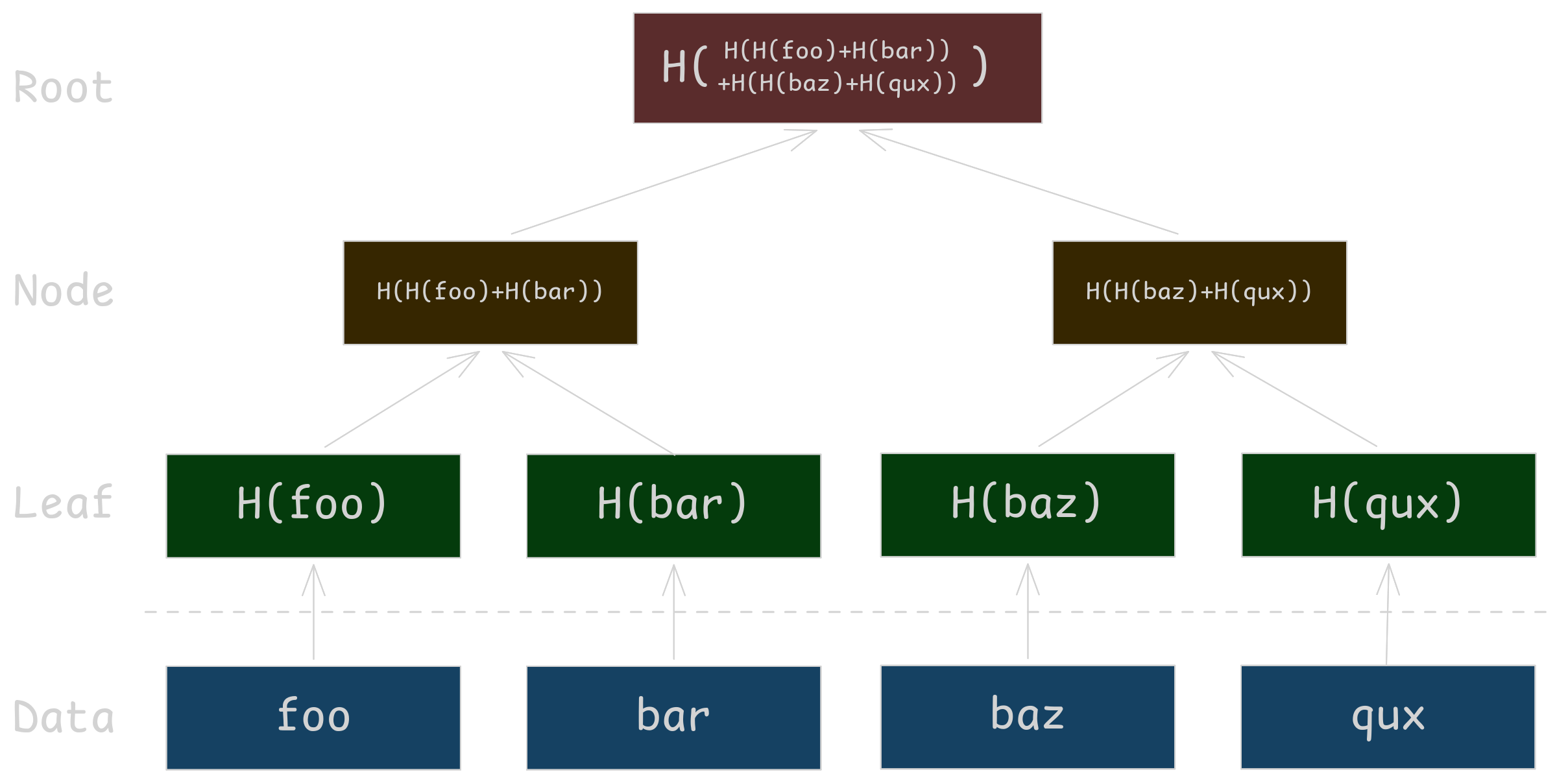
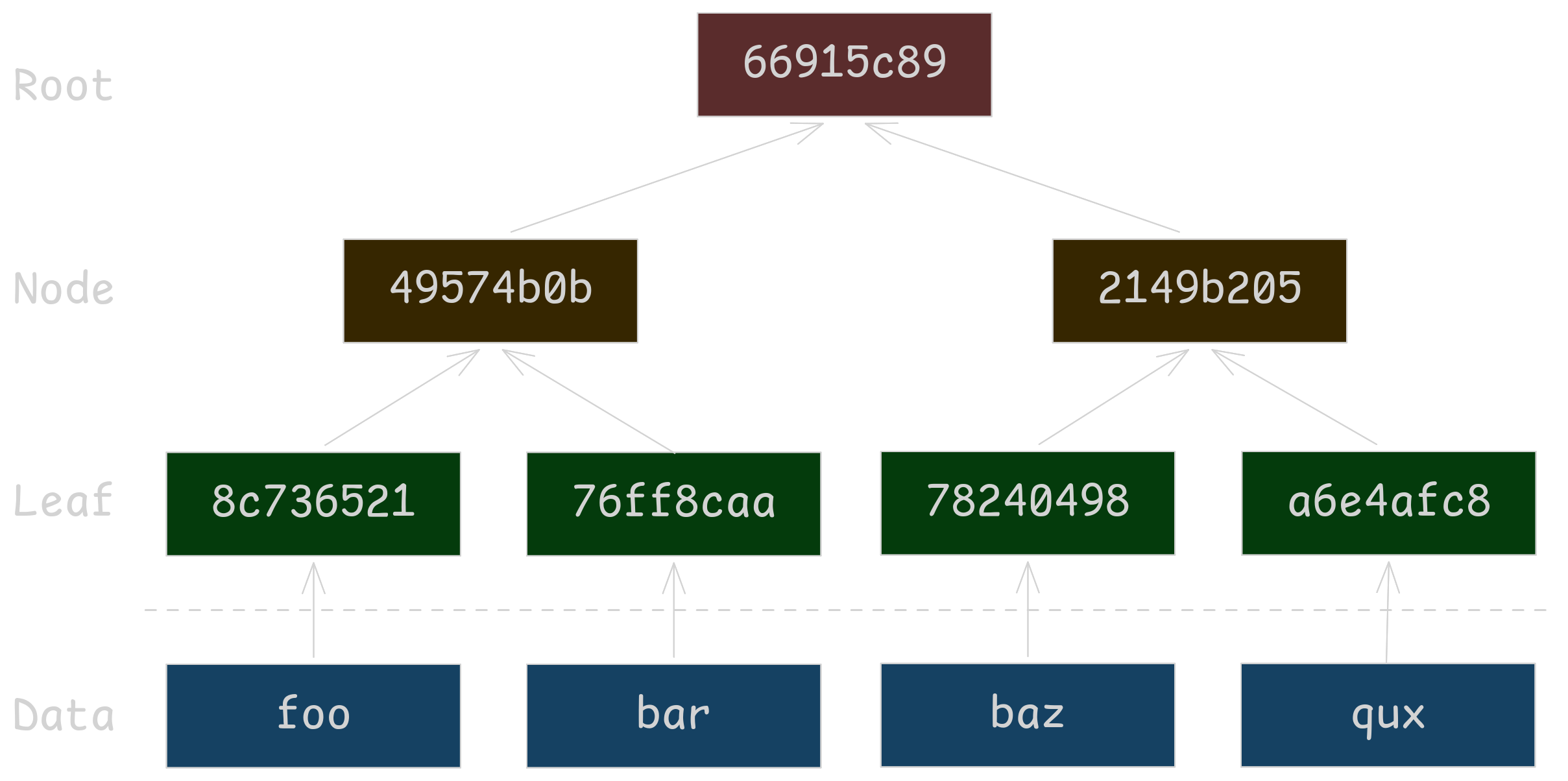
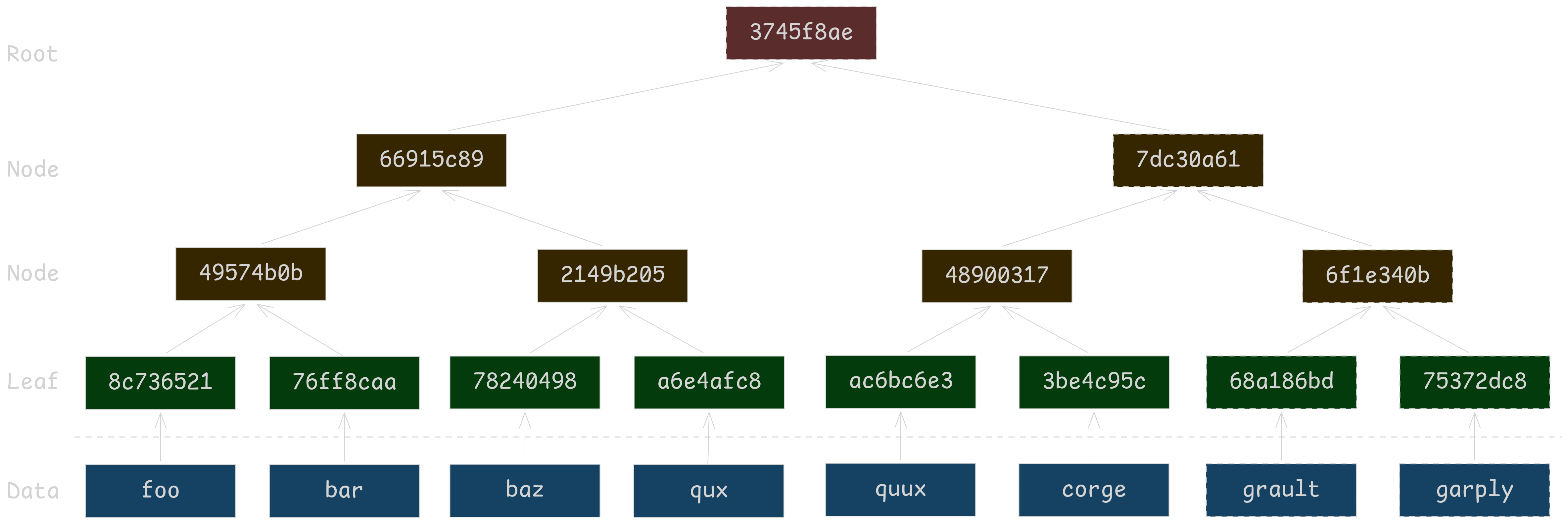
I’ve purposely chosen a non-cryptographic hash function (crc32) in
the above example in order to make the tree fit in a smaller space and
make it easy to follow along. CRC32 cannot protect
integrity against deliberate manipulation and must not
be used for cryptographic purposes. If you’d like to build the tree by
hand, you can use this bash function to compute the hashes. This is
portable-ish. My Fedora 44 system shipped with GNU cksum,
your box may not.
_crc_raw() {
    cksum -a crc32b | { read -r sum _; printf '%08x\n' "$sum"; }
}

crc() {
    if [ "$1" = -x ]; then
        shift
        local h
        if [ $# -gt 0 ]; then h=$(printf '%s' "$@"); else h=$(cat); fi
        h=${h//[[:space:]]/}
        if [[ ! $h =~ ^([0-9a-fA-F]{2})*$ ]]; then
            echo "crc: -x needs an even number of hex digits" >&2
            return 1
        fi
        printf '%b' "$(sed 's/../\\x&/g' <<<"$h")" | _crc_raw
    else
        if [ $# -gt 0 ]; then printf '%s' "$@"; else cat; fi | _crc_raw
    fi
}
Once you’ve pasted it into your shell it works as follows:
To hash a string crc foo yields 8c736521.
To hash hex formatted bytes crc -x 8c736521, which yields
849f8f2a. You can pass in multiple values for instance
crc -x 8c736521 76ff8caa, which concatenates the bytes
prior to hashing, this yields 49574b0b. So while following
along, hash input data without the -x, hash sibling nodes
to generate parent nodes with the -x.
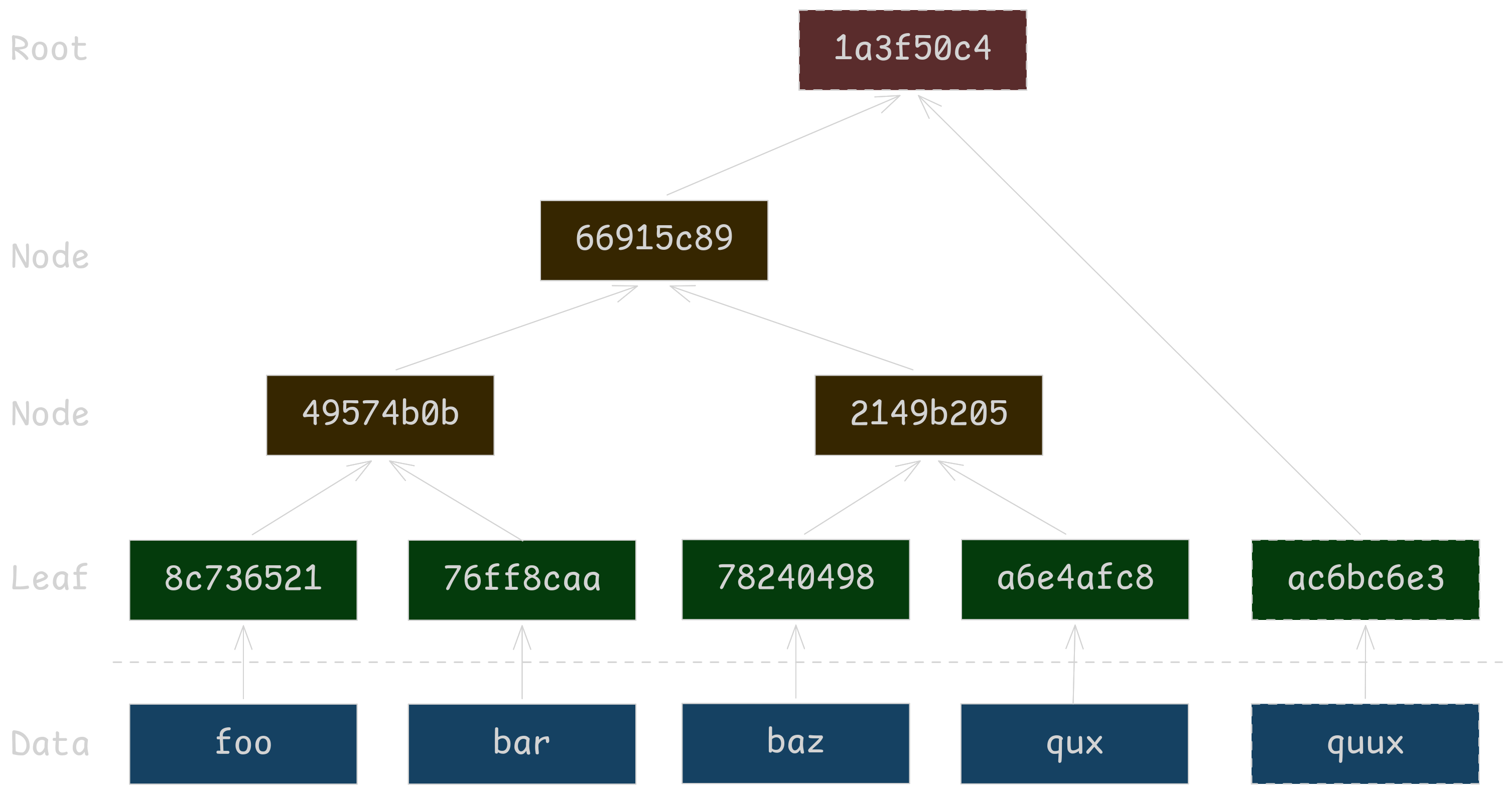
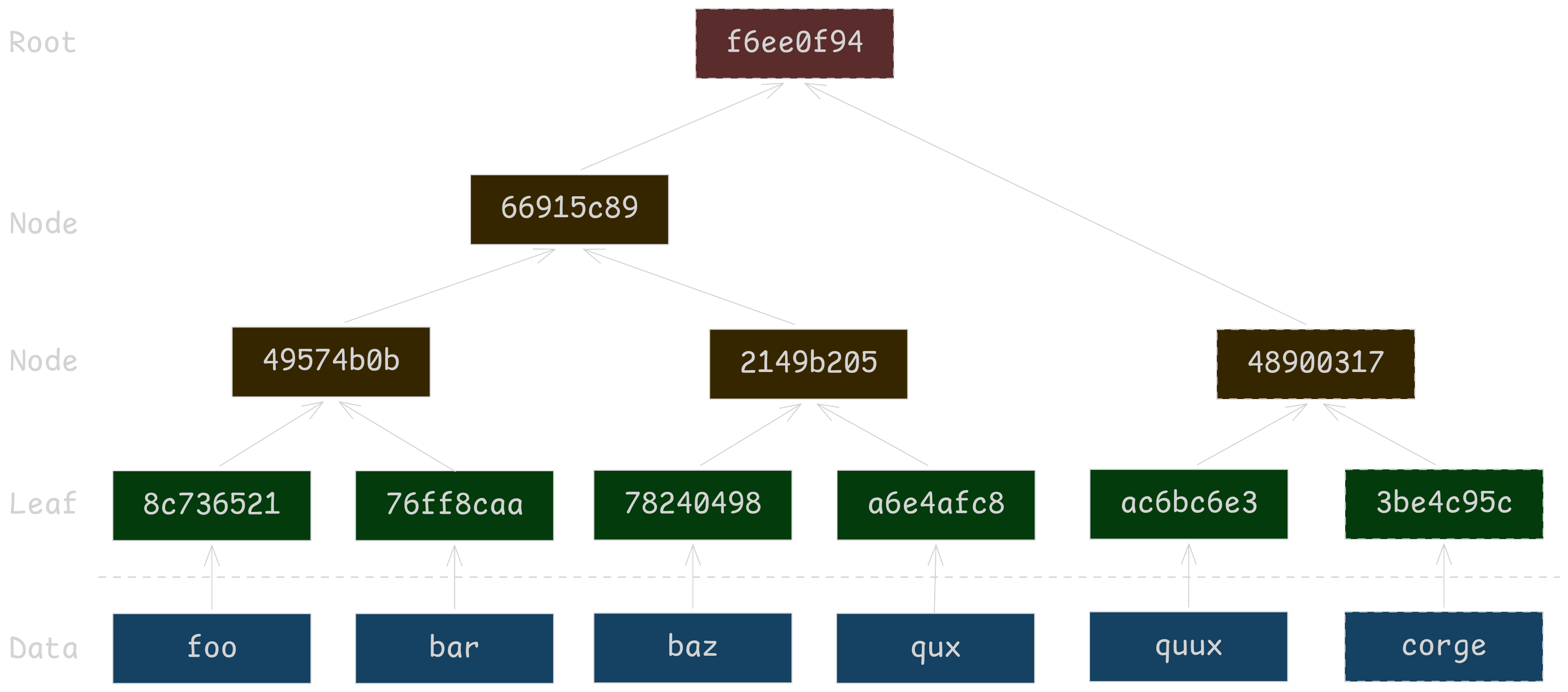
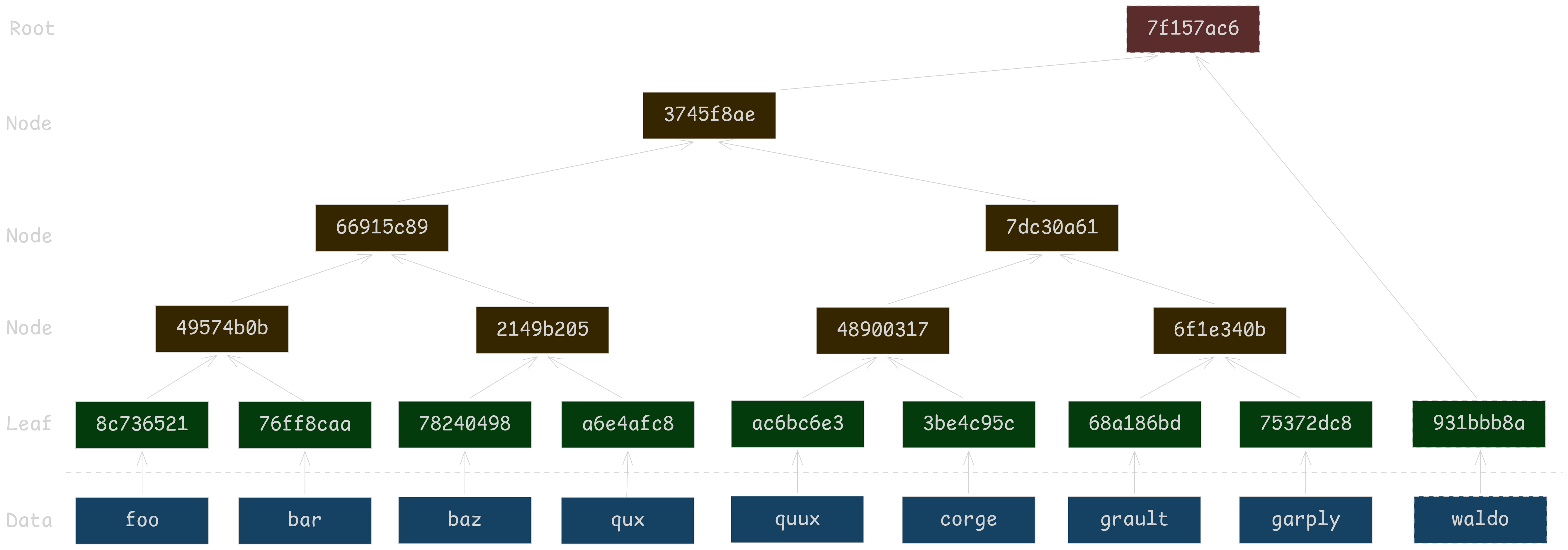
A few notes about the construction of this tree:
h=ceiling(log_2(n+1))-1 where n
is the total number of nodes and height is the number of edges on the
longest root-to-leaf path.0x01 before calculating internal node hashes
H(0x01 || left child hash || right child hash) and
0x00 before calculating leaf hashes
H(0x00 || cert_data). This is done for domain
separation, a common principle applied to many hashed structure
implementations.Proving an object is included in a Merkle Tree requires relatively
little data. If we have an object, we need the hash of its sibling, the
hash of its parent’s sibling and so on, up to the root. This means we
need at most h = ceiling(log_2(n+1) - 1) hashes, along with
left/right ordering to recompute a root hash for comparison against an
authenticated root.
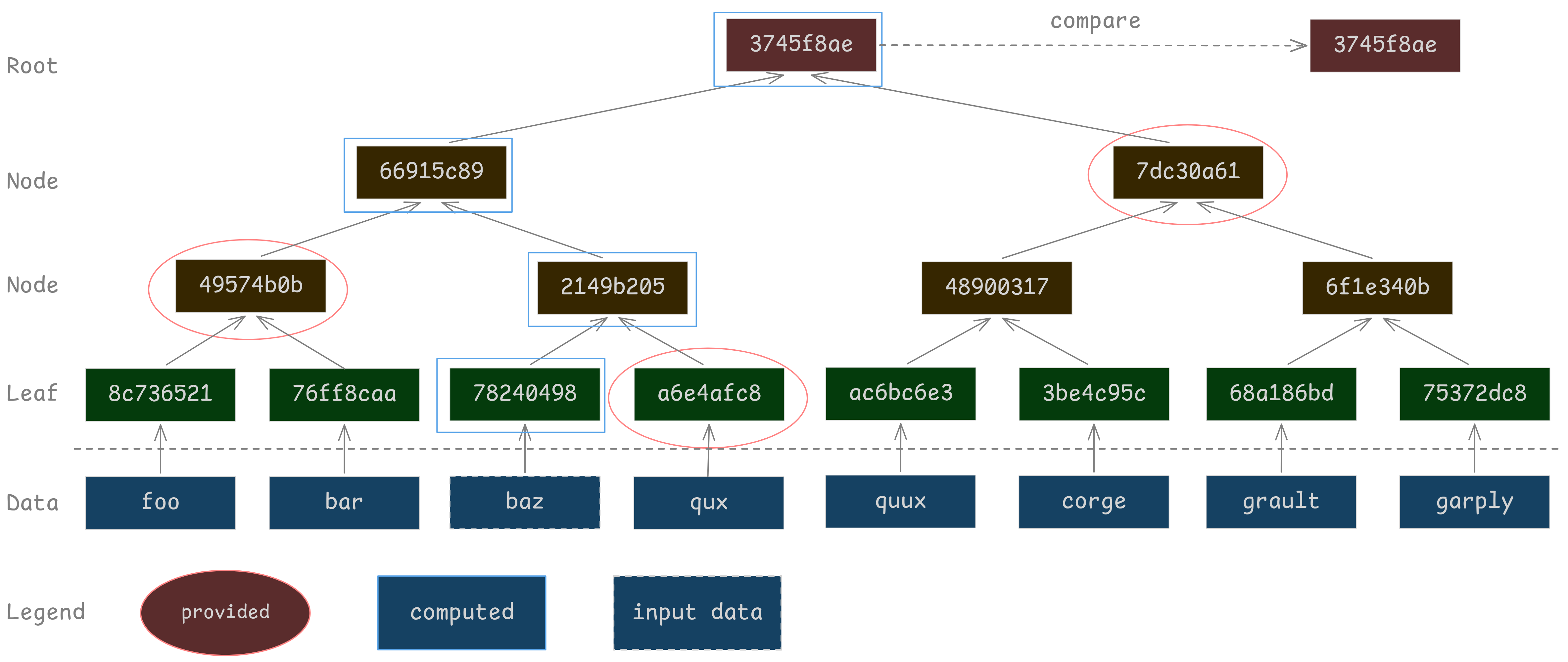
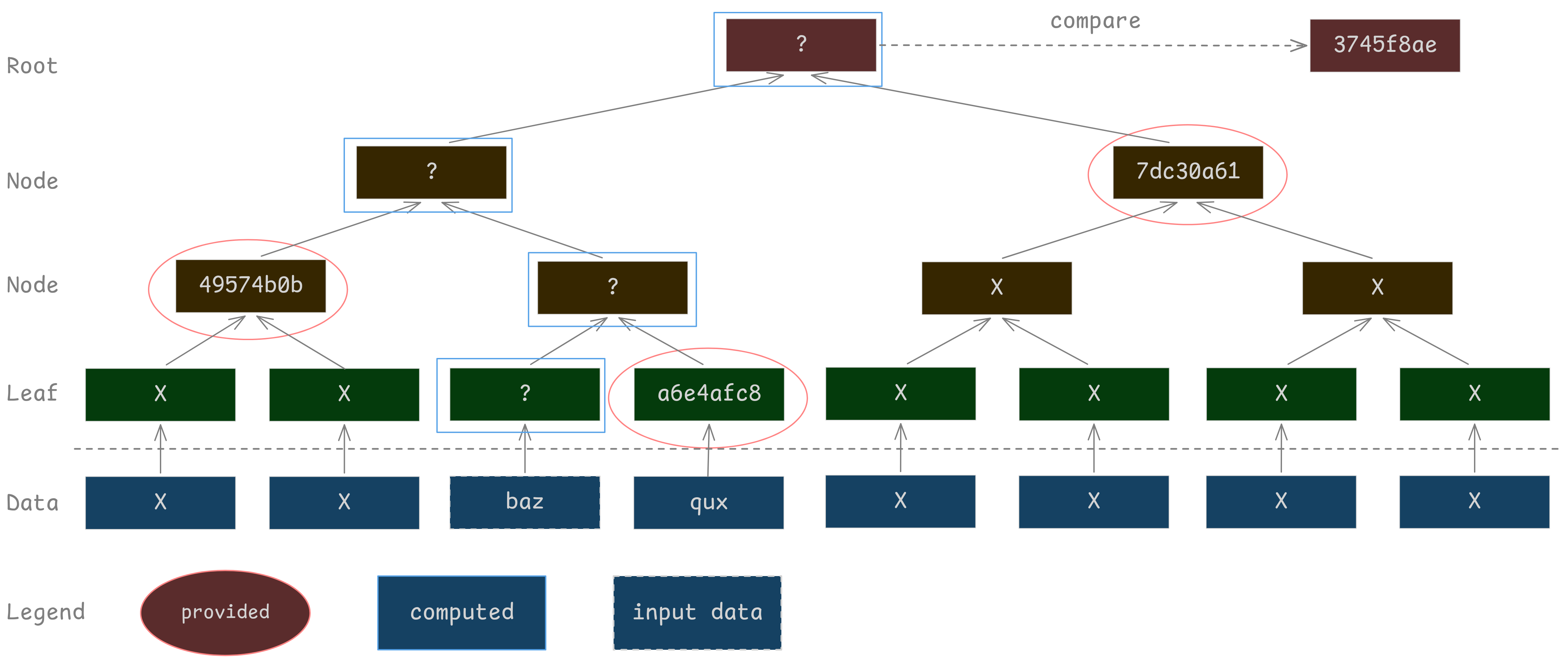
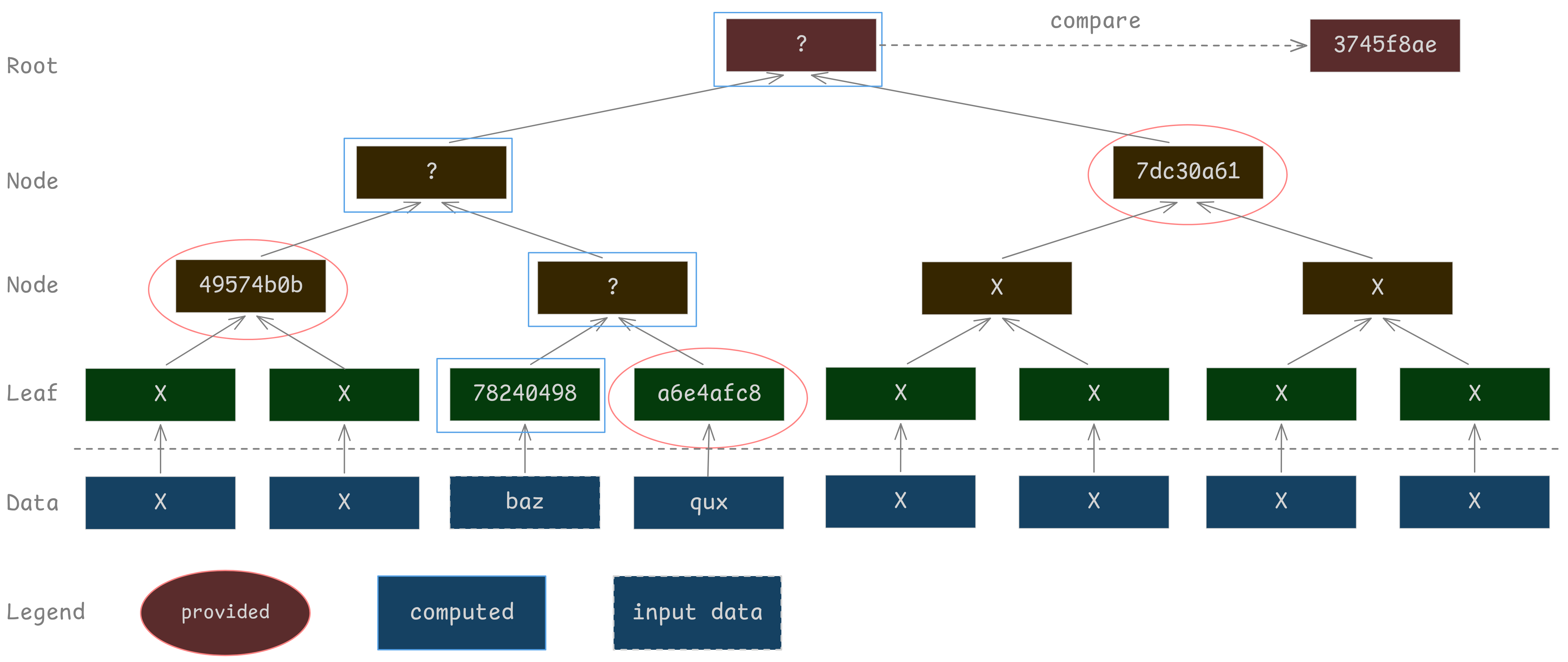
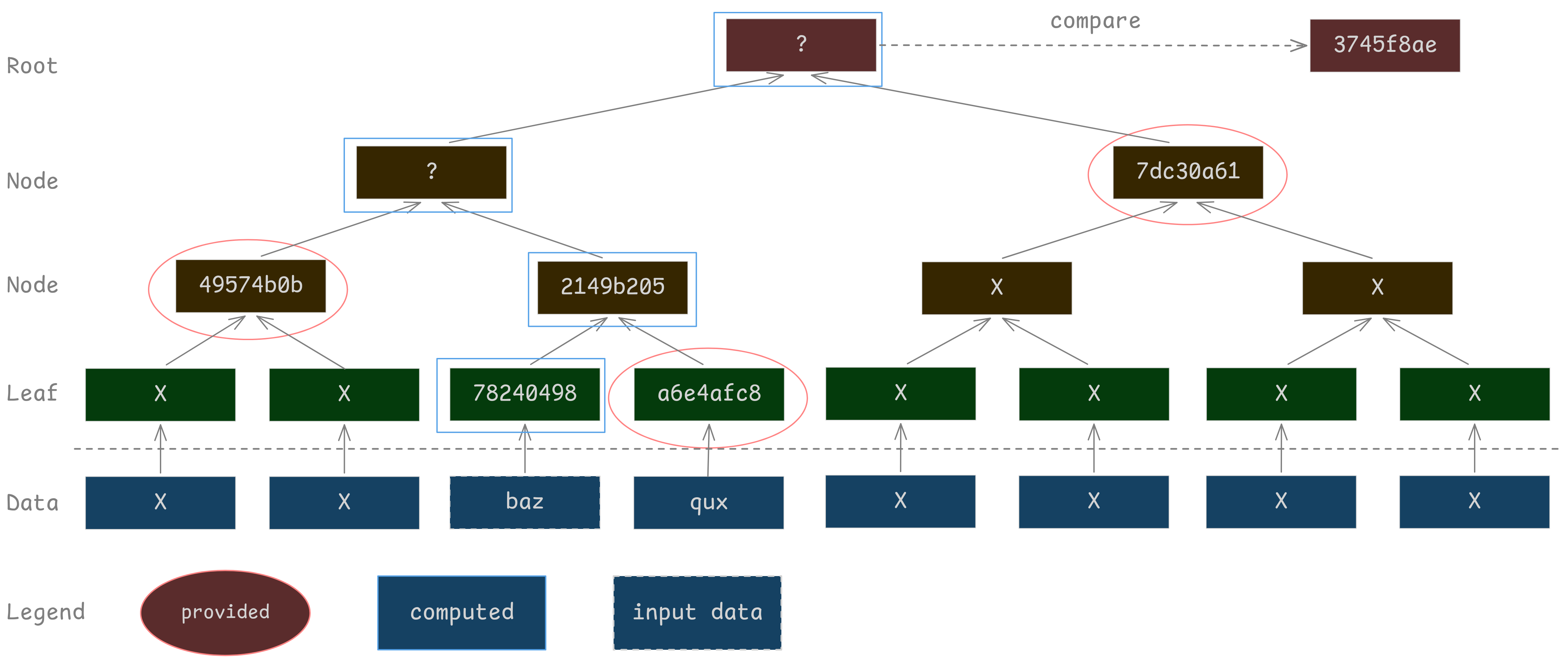
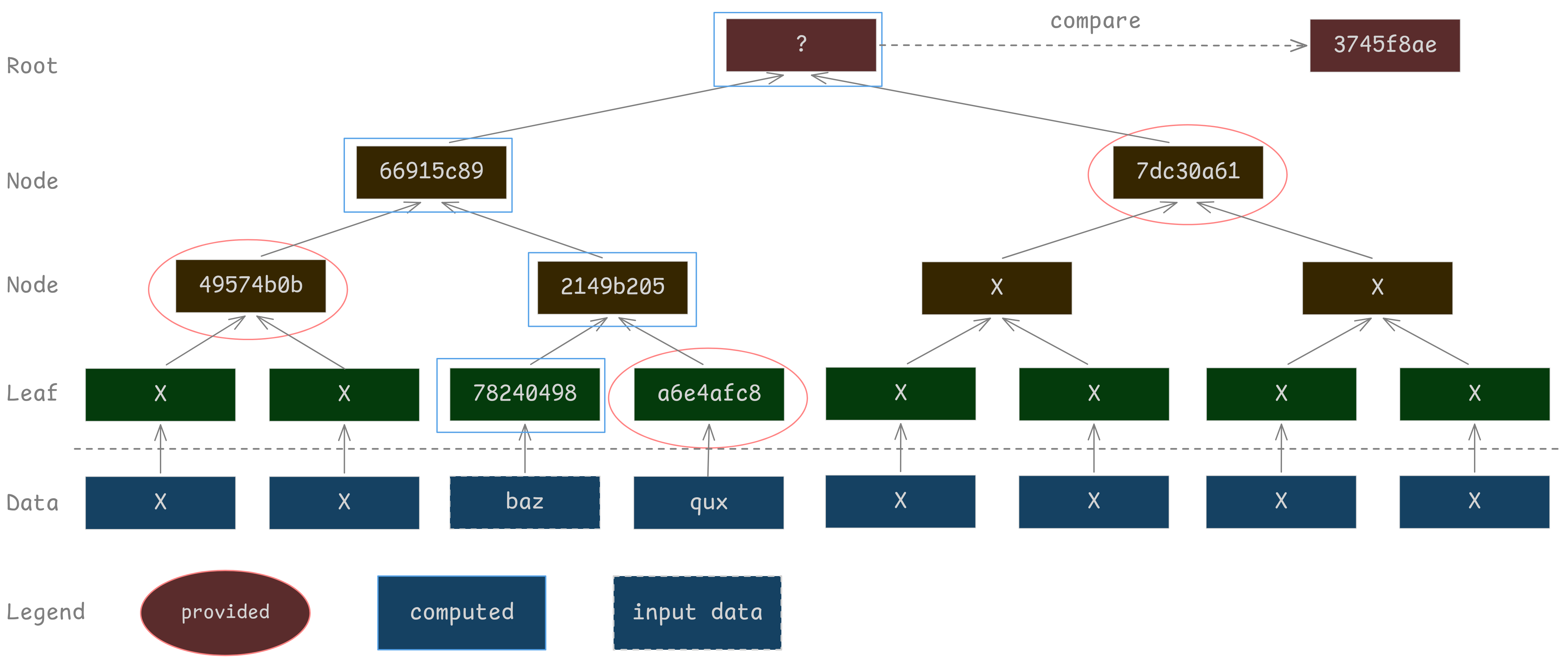
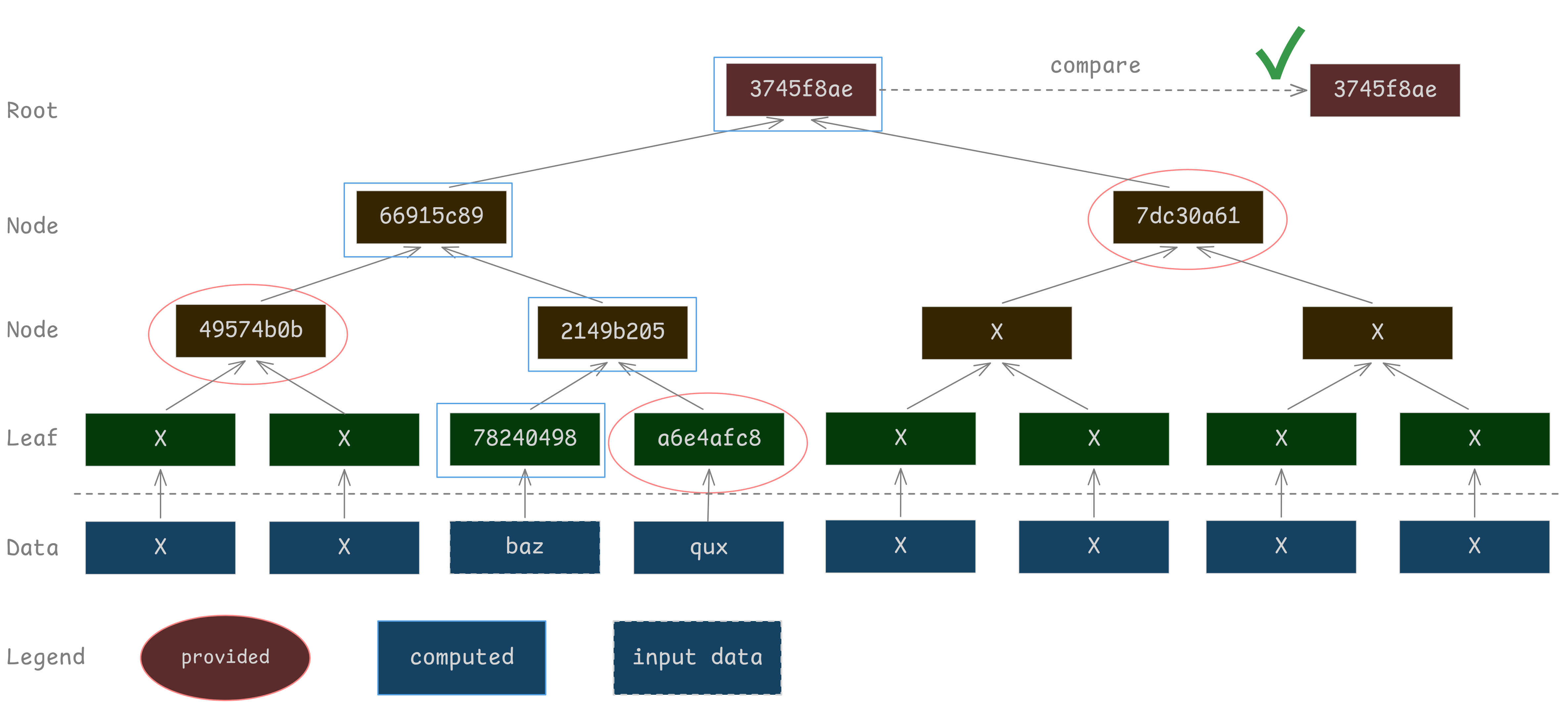
An inclusion proof tells us an object belongs to a tree represented by a root hash. Authentication of that root and integrity of an overall tree are different problems. In the next article we’ll look at how Certificate Transparency addresses those problems.